
Flat Rate vs Hourly Mechanic Pay: What Actually Works in 2026?
Jo Rosenberger
In the flat rate vs hourly mechanic pay debate, neither plan wins everywhere. Flat rate works best in shops with steady, predictable car count. Hourly works when volume swings. For most independent shops, a hybrid (a base hourly rate plus a production bonus) keeps good techs longest, as long as they can do the math on it.
The flat rate vs hourly mechanic pay debate has defined automotive compensation for decades. Flat rate rewards speed, it incentivizes production, and for a long time, it worked.
But something is shifting.
So what does this mean for shop owners? And more importantly, what does it mean for retention?
The answer isn’t simple. But it’s worth having honestly.
Key Takeaways: Flat Rate vs Hourly Mechanic Pay
- Flat rate rewards speed, but it puts the risk of slow weeks, warranty work and comebacks on the technician.
- Hourly pay gives techs a predictable paycheck, but shops lose the built-in push for production.
- A hybrid plan pairs a base hourly rate with a production bonus, which gives techs stability and shops an efficiency incentive.
- Techs decide faster when they can calculate their pay at 100% efficiency and in a slow week.
- The right pay plan depends on your car count, work mix, seasonality and technician level.
Is flat rate or hourly pay better for auto technicians?
Flat rate was built for a different era. Technicians were paid by the job, not the hour. If you were fast and skilled, you earned more. If you were slow, you felt it. The system rewarded efficiency and experience.
For high-volume shops with experienced technicians and consistent workflow, it still makes sense. A productive tech can out-earn a salaried employee by a wide margin. The upside is real.
But flat rate has a downside that doesn’t show up in the math right away. It shows up in morale.
A tech’s flat rate earnings aren’t just about how fast they work. They’re also a function of things completely outside their control; the season, how aggressively the service advisor is selling jobs, the mix of makes and models coming in that week, and how well the shop is marketed. A slow December isn’t the tech’s fault. But on flat rate, they feel it as if it were.
When the car count drops, techs absorb it. When a warranty job comes in, they absorb it. And when something takes longer than expected, they eat it. Over time, that unpredictability creates stress, and stress is one of the most consistent reasons techs leave.
Dealerships running flat rate tend to have more predictable volume and a narrower range of makes and models, which makes the math more reliable for techs there. But that specialization comes with a tradeoff: when those same technicians move to an independent shop, they often struggle with the wider variety of work. It’s a different skill set, and the flat rate structure at a dealership doesn’t necessarily prepare them for it.
| Which pay rate is better? | Flat rate | Hourly | Hybrid (base + bonus) |
|---|---|---|---|
| How techs get paid | By labor hours flagged per job | By hours on the clock | Base hourly plus a bonus above a production target |
| Works best when | Car count is steady and work mix is predictable | Volume swings or work is heavy on diagnosis | Most independent shops with some seasonality |
| What techs like | High earning ceiling for fast, experienced techs | A predictable paycheck | Stability plus upside |
| What techs worry about | Slow weeks, warranty work and comebacks cost them | A lower ceiling for top producers | Bonus targets that feel out of reach |
| Shop’s main risk | Turnover when volume drops | Less push for production | A plan too complex to explain in one conversation |
| Fits which tech | A techs at high-volume shops | C and B techs, and techs new to the trade | A, B and C techs, with targets set by level |
What problems does hourly pay solve for auto shops?
Shops that have moved to straight hourly often say the same thing: candidates who wouldn’t even talk to them before started returning calls.
That’s not an accident. For a lot of technicians, especially younger ones entering the trade, predictability matters more than upside. They want to know what they’re taking home on Friday. They want stability that flat rate doesn’t offer.
Hourly also reduces some of the tension around slow days, comebacks, and warranty work. Those things still happen. But the tech isn’t personally penalized every time they do.
The tradeoff is real too. Without production incentives, some shops find that efficiency drops. The urgency that flat rate creates can disappear. And for shops running lean on labor, that has a direct impact on the bottom line.
Why are more shops moving to hybrid technician pay?
The structure that’s gaining the most traction right now isn’t flat rate or hourly. It’s both. Most flat rate vs hourly mechanic pay discussions skip the third option.
A base hourly rate (enough to cover living expenses) combined with a production bonus when the tech hits a certain threshold. It gives techs the stability they want and the upside the shop wants.
This isn’t a new concept, but shops are implementing it more aggressively now because the talent market demands it. The shops winning on compensation aren’t always paying the most. They’re offering the most clarity.
Candidates want to understand what they’ll earn at 100 percent efficiency, what they’ll earn on a slow week, and what the realistic ceiling looks like. If they can’t calculate that quickly, the opportunity gets harder to say yes to.
What pay question should shop owners ask instead?
Most comp plan conversations start with the wrong question. Shops ask, “What can I afford to pay?” The better question is, “What do I need to offer to keep the technician I just hired?”
Those aren’t the same thing.
The data is clear that turnover is expensive. An open bay doesn’t just cost you a paycheck. It costs you productivity, customer capacity, and team morale. If a comp structure change reduces turnover by even one technician per year, it’s almost certainly worth it.
The shops that are getting this right aren’t just raising rates. They’re rethinking the structure entirely. They’re having direct conversations with their team about what stability looks like, what growth looks like, and how compensation fits into both.
For the full picture, see our guide on how to hire automotive technicians.
What do technicians want from a pay plan?
When you talk to technicians about why they leave or why they stay, compensation rarely comes up as the only reason. It’s usually tied to something else.
Uncertainty. Disrespect. No clear path forward. (We saw the same themes in our technician retention lessons from Shop Hackers 2026.)
After hundreds of cold calls to technicians across the country, we’ve never once heard someone say, “I’ll only work flat rate.” The assumption that techs are flat rate loyalists simply isn’t supported by the actual conversations. What techs want is to be paid fairly for their time and skill. The structure matters less than whether it feels honest and consistent.
Flat rate, especially at shops where the work isn’t consistent, creates a lot of uncertainty. Techs don’t know what next week looks like. That uncertainty doesn’t just affect their bank account. It affects their relationship with the job.
What techs are really asking for is to be treated like professionals. A comp structure that’s transparent, fair, and tied to their actual contribution. Not a system that punishes them for things outside their control.
If you want to know what techs in your market are actually expecting to take home, Promotive has internal data we use when advising shops on their comp structure- we’re happy to share this with all shops and break down your own Hiring Intelligence Report.
That might be flat rate with clear bonus thresholds. It might be hourly with a production component. It might be something specific to your shop’s model. But it starts with asking the question and being willing to have an honest conversation about the answer.
How do you choose between flat rate vs hourly mechanic pay?
The flat rate vs hourly mechanic pay conversation doesn’t have a universal answer. The shops that handle comp plans best aren’t the ones with the most generous structure. They’re the ones that communicate it the clearest and have it match their shop’s seasonality, job type and level of tech.
A well-explained flat rate can retain a great tech. A poorly explained hourly rate can lose a great candidate at the offer stage. Clarity is the competitive advantage most shops are missing. A confusing pay plan is also one of the reasons automotive technicians don’t apply in the first place
If you’re losing candidates at the offer stage or seeing turnover inside the first 90 days, your comp plan is worth looking at. Not because it’s wrong, but because it might not be landing the way you think it is.
This is one of the most talked-about topics in automotive right now. There’s no shortage of opinions on it. What’s less common is the data and the willingness to have an honest conversation about what’s actually working.
How can Promotive help you see what techs in your market expect?
Compensation expectations vary significantly by region, shop type, and technician tier. What’s competitive in one market can be below average in another.
Think about how a great tech approaches a car they’ve never seen before versus one they’ve worked on a hundred times. The experience changes everything: the questions they ask, the time it takes, the confidence in the answer. We’ve spent years working in the independent auto shop space. We’re not running a general search. We’re reading your industry’s specific and telling you exactly what we’re seeing.
If you want a clearer picture of what the comp landscape looks like in your area, what techs are being offered, what’s moving them, and where the gaps are, we’re always happy to share what we’re seeing.
FAQs About Flat Rate vs Hourly Mechanic Pay
Neither is better everywhere. Flat rate suits shops with steady, predictable volume and fast, experienced techs. Hourly or hybrid pay usually works better when car count or work mix swings.
It depends on the tech and the shop. Experienced techs at busy shops often like flat rate’s earning ceiling, while many others want the predictability of an hourly base. Most care more about a plan they can understand and trust than about the format.
A hybrid plan pays a base hourly rate plus a production bonus once a tech passes a set efficiency or hours target. It gives techs a steady paycheck and gives the shop a reason for techs to keep production up.
Usually because their pay swings with things they don’t control, like slow weeks, warranty work, comebacks or how much the service advisor sells. When volume drops, flat rate techs feel it in their paycheck first.
Show them the numbers: what they’d earn at 100% efficiency, in a slow week, and at the top of the plan. If a candidate can’t do that math quickly, the offer gets harder to say yes to.
Last updated October 22, 2026
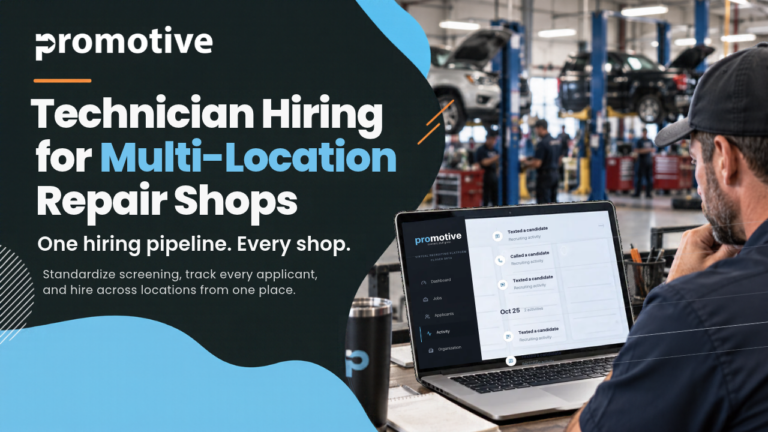
Technician Hiring for Multi-Location Repair Shops
One hiring pipeline for every shop you run. Open jobs by location, get a prescreen summary on every applicant before you call, and let our recruiters work the pipeline while you run your shops. Last updated: October 27, 2026 Technician hiring for multi-location shops works best when every store hires the same way. That means…

How to Choose an Automotive Recruitment Service for Multi-Location Shops (2026)
Last updated: October 27, 2026 · Promotive wrote this guide and is one of the options listed. To choose an automotive recruitment service for a multi-location shop, start with two questions: who finds and screens your techs, and can you see hiring by location? Recruiters source and screen for you. Hiring software gives your managers…
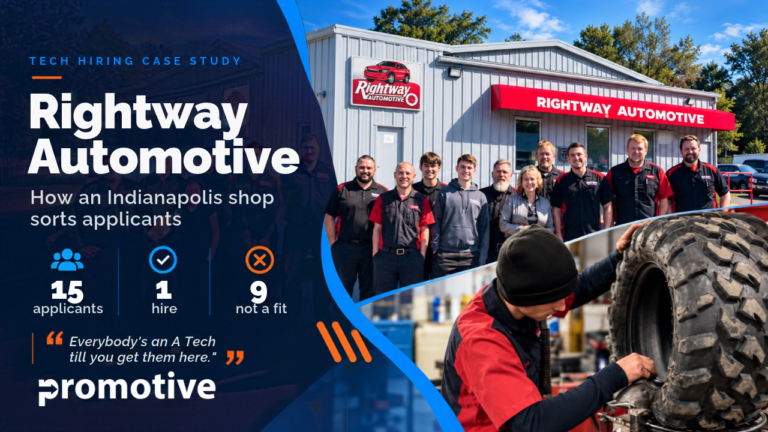
Tech Hiring Case Study: How an Indianapolis Shop Sorts Applicants
“Everybody’s an A Tech Till You Get Them Here” Written by: Jo Rosenberger Last Revision: October 20, 2026 This tech hiring case study looks at how Rightway Automotive, a family-owned shop in Indianapolis, uses the Promotive platform to review applicants and hire on its own schedule. For one technician opening, Rightway got 15 applicants, sorted…
Why Auto Shops Lose Technicians (and What Hiring Alone Won’t Fix)
Last updated: October 27, 2026 · Auto shops lose technicians mostly for reasons inside the shop: an unpredictable flat-rate board, a bad work mix, a service manager techs don’t trust, missing equipment, no training path and schedules that eat Saturdays. Recruiting adds a second layer: the wrong skill level, slow hiring, an oversold job and…

How to Vet Auto Technicians: The Complete Guide to Skills, Certs and Shop Fit
Last updated: October 11, 2026. To vet auto technicians, check three things in order: the skills they can prove, the certifications they actually hold, and their fit with your pay plan, schedule and culture. Screen the resume, run a short prescreen call, verify ASE credentials, and test diagnostic skills. Then call the managers who supervised…

Losing Techs Before The Interview
Independent auto shops are losing techs before the interview because of slow responses, confusing job posts, and complicated applications, not because technicians found better jobs. Most shop owners think the hiring battle happens during the interview. It actually happens in the 24 to 48 hours after a technician hits “apply,” and right now most of…