
Auto Repair Shop Management Mistakes That Cost One Owner $40K a Month
Jo Rosenberger
The most useful session at Shop Hackers 2026 didn’t open with a framework or a slide about mindset. It opened with a shop owner walking the room through his own auto repair shop management mistakes: the specific, dollar-for-dollar cost of each one, and the four unglamorous fixes that turned his numbers around. No new equipment. No new location. Just decisions he’d been avoiding.
Knowing Better Isn’t the Same as Doing Better
His framing for the whole talk was simple: knowledge doesn’t make you a better leader. Doing something with it does. He knew his technicians shouldn’t be self-dispatching. He knew a two-day estimate turnaround was killing his close rate. He knew the job board on his wall was decoration. None of that knowledge changed anything until he actually acted on it, and admitting that gap, out loud, in front of a room of shop owners, was the point of the talk.
Here’s what he found when he finally looked.
Problem 1: His Technicians Were Running the Shop
Every technician was self-dispatching. They’d walk up to the ticket rack, pick whatever job looked easiest or most interesting, and leave the rest. The predictable result: the good, fast, easy tickets moved. Everything else sat.
The fix was uncomfortable but simple. He started dispatching every ticket himself, matching jobs to each tech’s speed and strengths, and deliberately mixing in a hard ticket with an easy one (what he called “the sandwich”). It’s a hard conversation to have with a strong, flat-rate technician who’s used to picking his own work. He was honest that it only works if the leader is willing to have that conversation and stick with it.
Problem 2: Estimates Took Two Days, Not Two Hours
Customers were sometimes waiting two full days to hear back on an estimate. By the time they did, they’d often already gone somewhere else, or lost interest. He set a hard internal target: every estimate delivered within two hours of the vehicle coming in, enforced with a shop-wide “one ticket at a time” rule so technicians couldn’t grab a stack and disappear to the back for hours.
The result he shared: average repair order value went from around $300 to around $800. Speed, not upselling, was the lever.
Problem 3: The Job Board Was a Prop
He’d already installed a whiteboard dispatch and production board, the kind most shop management courses recommend. It just wasn’t being used. It hung on the wall looking official while the actual chaos continued underneath it.
The fix wasn’t a better board. It was two huddles a day: one first thing in the morning (7:30, before anyone could grab a ticket), and one mid-afternoon, where the whole team checked status together and the board actually got updated in real time (who’s waiting on parts, who’s ahead of schedule, who needs a lighter ticket next). The huddle is what made the board real. Without it, the board was just paint.
Problem 4: The Shop’s Default Answer Was “No”
Small stuff, but it added up. Can you get me in this week? No. Can you call me back today? Not now. He estimated his team was converting roughly one in five of those small yes-or-no moments, an 80% “no” rate on things that mostly just needed a little more effort to say yes to. Flipping the default answer to “yes, here’s how” wherever it was actually possible to deliver on it drove a meaningful chunk of the additional car count on its own, with no ad spend required.
The Math Behind the Turnaround
He walked the room through the actual numbers, and they’re worth sitting with.
His overhead cost per hour (total overhead divided by billed hours) was $180. His gross profit per hour was $135. That’s a $45-per-hour deficit before he’d done anything else. There are only two ways to fix that ratio: cut expenses, or bill more hours. He’d already cut what he could, so he went after billed hours, adding roughly six more billed hours a day, which compounds fast over a month.
On the other side of the equation, he tightened gross profit per hour through a strict labor rate and consistent use of a parts matrix (“smart estimating”), making sure every job that should include a control arm, not just a ball joint, actually did.
Add it up: better dispatch, faster estimates, a board that was actually used, a default “yes,” and tighter margins per hour, and the shop added roughly $40,000 to the bottom line in about a month. His words for what that felt like: “I exhaled for the first time in a year and a half of owning my shop.”
The Auto Repair Shop Management Mistakes to Fix First
Strip away the story and it’s four repeatable mistakes: letting technicians self-dispatch instead of the shop controlling the queue, tolerating a multi-day estimate turnaround, installing a production board and never actually running it, and defaulting to “no” on small scheduling asks. None of the four required capital, a new hire, or new software to fix. They required an owner willing to stop making excuses for a board nobody used and a dispatch process nobody was actually running.
That’s also the piece worth sitting with if you’re thinking about growth. A shop drowning in $180-an-hour overhead with no dispatch discipline and no real production tracking isn’t in a position to add headcount well; a new hire just gets absorbed into the same chaos. Fix the management mistakes first, the way this owner did, and the next hire actually has a system to plug into instead of a mess to inherit.

Automotive Recruiting Agency vs Job Boards: Which Fills Your Bay Faster?
Last updated: November 10, 2026 · By Jo Rosenberger An automotive recruiting agency usually fills a technician job faster than a job board when the role is hard to fill or you don’t have time to chase applicants. A job board is cheaper and faster to start, but you do the sorting, calling and screening…
The Automotive Technician Hiring Process: 10 Steps to Hire Good Techs in 2026
Last updated: November 20, 2026 · By Jo Rosenberger A good automotive technician hiring process is the same 10 steps, run the same way every time. Define the role, build a scorecard, source from several channels and reply to applicants the same day. Then prescreen, interview, check skills, make a written offer, onboard for 90…
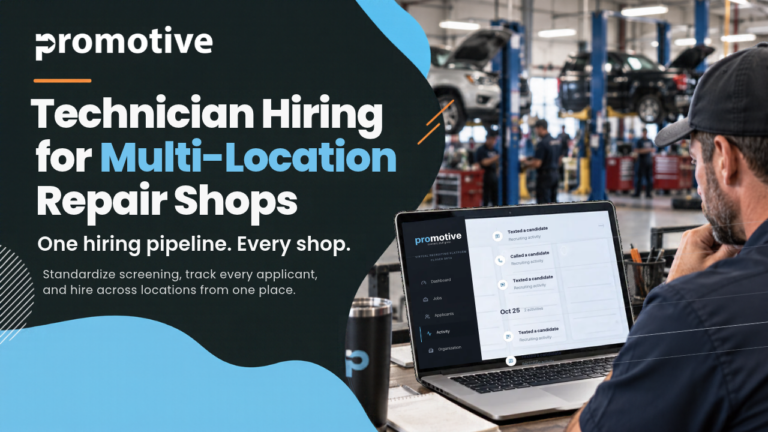
Technician Hiring for Multi-Location Repair Shops
One hiring pipeline for every shop you run. Open jobs by location, get a prescreen summary on every applicant before you call, and let our recruiters work the pipeline while you run your shops. Last updated: October 27, 2026 Technician hiring for multi-location shops works best when every store hires the same way. That means…

How to Choose an Automotive Recruitment Service for Multi-Location Shops (2026)
Last updated: October 27, 2026 · Promotive wrote this guide and is one of the options listed. To choose an automotive recruitment service for a multi-location shop, start with two questions: who finds and screens your techs, and can you see hiring by location? Recruiters source and screen for you. Hiring software gives your managers…
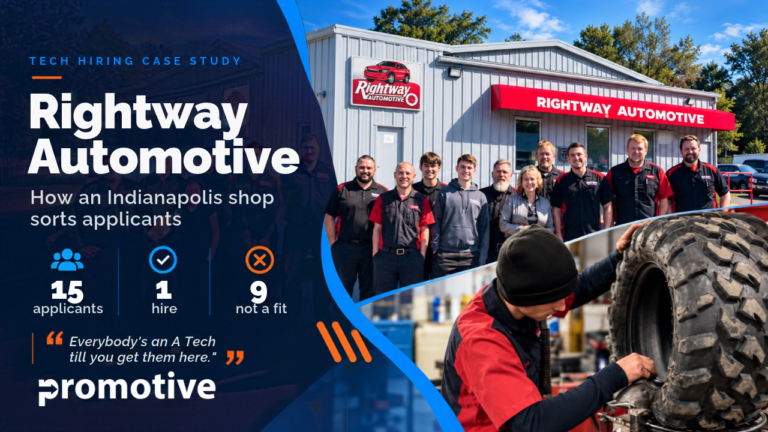
Tech Hiring Case Study: How an Indianapolis Shop Sorts Applicants
“Everybody’s an A Tech Till You Get Them Here” Written by: Jo Rosenberger Last Revision: October 20, 2026 This tech hiring case study looks at how Rightway Automotive, a family-owned shop in Indianapolis, uses the Promotive platform to review applicants and hire on its own schedule. For one technician opening, Rightway got 15 applicants, sorted…
Why Auto Shops Lose Technicians (and What Hiring Alone Won’t Fix)
Last updated: October 27, 2026 · Auto shops lose technicians mostly for reasons inside the shop: an unpredictable flat-rate board, a bad work mix, a service manager techs don’t trust, missing equipment, no training path and schedules that eat Saturdays. Recruiting adds a second layer: the wrong skill level, slow hiring, an oversold job and…