
Trailblazers: Women in Automotive Through the Decades
Promotive

In our male-dominated industry, there is a remarkable community of intelligent, determined, and downright amazing women in automotive. Promotive is a women-led organization and we acknowledge the challenging journey that has brought us to this point. While times have greatly improved, women have historically faced unfair biases. Accordingly, they feel the need to work just a little bit harder to prove themselves. These challenges include:
Limited Access to Education and Training
In the early years of the automotive industry, women faced barriers to accessing education and training in engineering, design, and other technical fields related to automobiles.
Societal Gender Stereotypes
Deep-rooted gender stereotypes often led to the belief that women were not suited for roles in the automotive industry, reinforcing a culture of exclusion and discrimination.
Lack of Representation and Opportunities
Women were often overlooked for employment opportunities in automotive companies, with hiring practices favoring men and offering limited advancement prospects for women.
Hostile Work Environments
Women who did manage to break into the automotive industry faced hostile work environments, including harassment and discrimination, making it difficult for them to thrive and succeed in their careers.
Unequal Pay and Recognition
Even when women were able to secure positions in the automotive industry, they often faced unequal pay compared to their male counterparts and a lack of recognition for their contributions and achievements.
Despite these challenges, women have persevered and made significant contributions to the automotive industry. Amazingly, they challenged stereotypes, broke through barriers, and paved the way for future generations of women in the field.
Now, let’s meet a few of the trailblazers that broke through barriers as women in automotive:
Late 1800s: An Early Pioneer
Bertha Benz – Helping her husband Carl Benz with his design for the first horseless carriage, Bertha refused to let the skeptics stand in their way. She took the first long-distance automobile journey in 1888, with her sons in tow and without prior discussion with her husband. Her journey contributed significantly to promoting the viability of automobiles. Essentially, without Bertha, the vehicles we drive today may never have existed.
Source: Mercedes Benz Group
Mid-to-Late 1900s: Shaping the Industry
Helene Rother – Helene faced numerous challenges as a European immigrant and single mother. She moved her daughter from Paris to New York in hopes of a brighter future. Despite these obstacles, she persevered and eventually found her way to General Motors in 1943. Breaking barriers, she became the first woman to work as an automotive designer at the company. Her specialization in automotive interiors can be seen in the modern internal structures of vehicles today.
Source: Hemmings
Margaret Dunning –
Margaret, a friend and neighbor of Henry Ford, possessed a talent for “fixing” things. Renowned for her restoration work and vintage car collection, she ignited a passion for automobiles in generations to come. Despite her advanced age, Margaret’s dedication to learning remained undiminished. At 102 years old, she earned a full scholarship to the University of Michigan. Although she passed away two years later, her legacy endures through the Margaret Dunning Foundation.
Source: Margaret Dunning Foundation
Rita Case – Rita’s father, a dealership owner, introduced her to the automotive world at the age of 8. She later took over the family business and, together with her husband Rick, founded Rick Case Automotive Group. The couple began by purchasing franchised dealerships and were awarded the first Acura and Hyundai dealerships in the U.S. As the company’s current CEO, Rita has received numerous national awards and recognition for her contributions. Rita also has a reputation of giving back and, to date, has raised over 100 million dollars for a variety of nonprofit organizations. Rita is also a jet pilot.
Source: Rick Case Automotive Group
2000’s: Rising Stars of our Time
Sheryl Connelly – As the former Chief Futurist for Ford Motor Company, Sheryl played a key role in shaping the company’s long-term strategy. Her duties involved identifying global trends, assessing their potential implications, and disseminating futuring insights across various departments, including design, product development, and corporate strategy. Sheryl’s expertise has earned her recognition as one of the Most Influential Women in Futuring by Forbes Magazine, as well as acknowledgment as one of the Most Creative People in Business by Fast Company. TechWeek also included her in its Top 100 list. Since retiring, Sheryl freelances as a professional public speaker, sharing her insights and expertise with audiences worldwide.
Source: Sheryl Connelly
Mary Barra – Mary made history in 2014 as the first female CEO in the automotive industry. Leading General Motors’ charge in electric vehicles, she spearheaded the introduction of several EV models, including the Chevrolet Bolt EV and the GMC Hummer EV. Mary’s groundbreaking leadership has garnered widespread recognition, with Forbes, Fortune, and Time acknowledging her as one of the most influential women in business. In 2023, she was further honored with induction into the Automotive Hall of Fame. Mary’s impact extends beyond accolades, reshaping General Motors’ trajectory towards innovation and sustainability in profound ways.
Source: Automobile Hall of Fame
These women, along with many others in various roles within the automotive industry, continue to drive innovation and shape the future of vehicles as we know them.
How to Fill Hard-to-Fill Technician Roles (When Nobody’s Applying)
Last updated: November 16, 2026 · By Jo Rosenberger Hard-to-fill technician roles, like A techs, diagnostic and electrical techs, diesel techs and experienced service advisors, stay open because most qualified people already have jobs and aren’t applying. To fill them, make your offer competitive for your market, go to the techs who aren’t looking, move…

Automotive Recruiting Agency vs Job Boards: Which Fills Your Bay Faster?
Last updated: November 10, 2026 · By Jo Rosenberger An automotive recruiting agency usually fills a technician job faster than a job board when the role is hard to fill or you don’t have time to chase applicants. A job board is cheaper and faster to start, but you do the sorting, calling and screening…
The Automotive Technician Hiring Process: 10 Steps to Hire Good Techs in 2026
Last updated: November 20, 2026 · By Jo Rosenberger A good automotive technician hiring process is the same 10 steps, run the same way every time. Define the role, build a scorecard, source from several channels and reply to applicants the same day. Then prescreen, interview, check skills, make a written offer, onboard for 90…
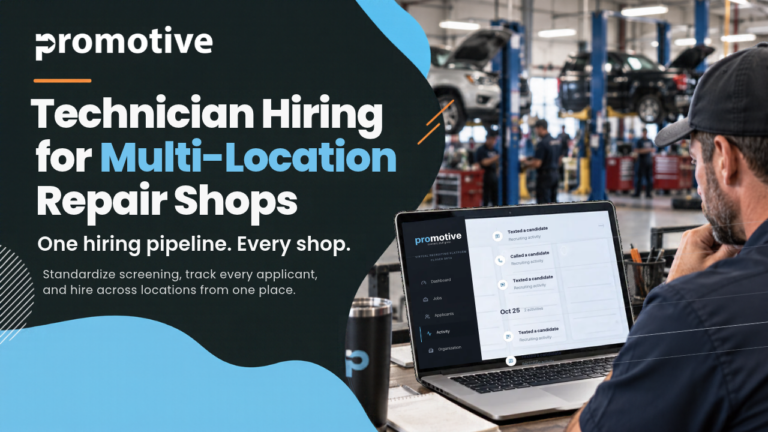
Technician Hiring for Multi-Location Repair Shops
One hiring pipeline for every shop you run. Open jobs by location, get a prescreen summary on every applicant before you call, and let our recruiters work the pipeline while you run your shops. Last updated: October 27, 2026 Technician hiring for multi-location shops works best when every store hires the same way. That means…
How to Choose an Automotive Recruitment Service for Multi-Location Shops (2026)
Last updated: October 27, 2026 · Promotive wrote this guide and is one of the options listed. To choose an automotive recruitment service for a multi-location shop, start with two questions: who finds and screens your techs, and can you see hiring by location? Recruiters source and screen for you. Hiring software gives your managers…
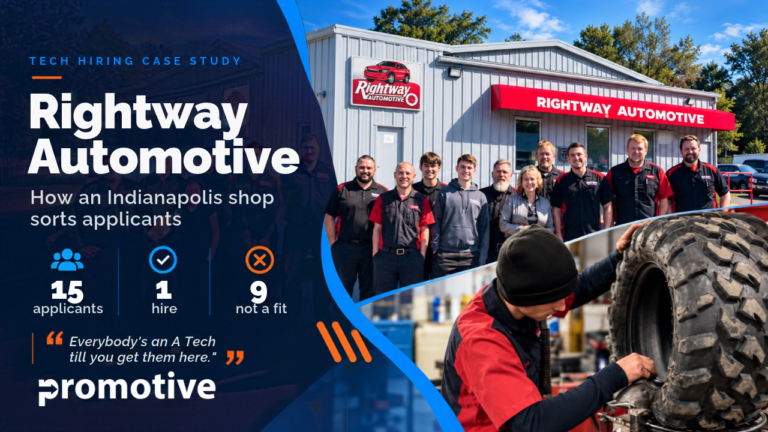
Tech Hiring Case Study: How an Indianapolis Shop Sorts Applicants
“Everybody’s an A Tech Till You Get Them Here” Written by: Jo Rosenberger Last Revision: October 20, 2026 This tech hiring case study looks at how Rightway Automotive, a family-owned shop in Indianapolis, uses the Promotive platform to review applicants and hire on its own schedule. For one technician opening, Rightway got 15 applicants, sorted…